
How to Tell if Your Existing IUL Was Designed Properly
A closer look at the funding, death benefit, riders, and cash value performance factors that can impact whether your Indexed Universal Life policy is aligned with your long-term goals.
4/9/2026
Have Questions About Your Financial Options and Long-Term Goals?
Many people are drawn to Indexed Universal Life (IUL) insurance because it combines life insurance protection with the potential for cash value accumulation tied in part to the performance of a market index. However, not every IUL policy is structured the same way, and policy design can materially affect how a policy performs over time.
If you already own an IUL policy, it may be worthwhile to review whether it was designed in a way that aligns with your original goals and your current needs. A policy review can help identify whether the policy’s funding, death benefit structure, riders, charges, and overall performance are still appropriate based on your circumstances.
Key Elements of a Properly Structured IUL
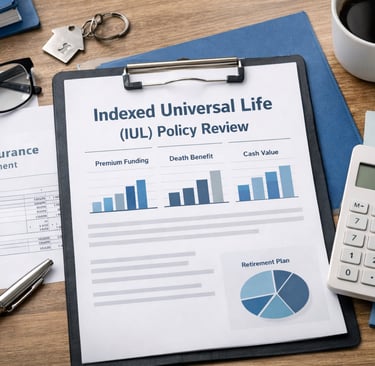
A properly structured IUL is not simply about having life insurance coverage in place. It also involves how the policy was designed, funded, and maintained over time. When reviewing an existing IUL, several core areas deserve attention, including the death benefit, premium funding, riders, policy charges, and cash value performance.
Death Benefit Structure
One of the first things to review is how the death benefit is set up. Some policies are designed primarily for life insurance protection, while others are structured with greater emphasis on potential cash value accumulation. This often involves the choice between different death benefit options, such as level or increasing death benefit designs.
The death benefit structure can affect internal policy costs, cash value growth potential, and long-term flexibility. If your goals have changed since the policy was issued, or if the original design prioritized one outcome over another, it may be appropriate to evaluate whether the structure still fits your objectives.
Premium Funding
Funding is one of the most important factors in how an IUL policy performs. Policies funded at lower levels may build less cash value and may be more sensitive to policy charges over time. In some situations, higher funding levels within applicable IRS guidelines may improve policy efficiency, but that depends on the policy design, timing, charges, and individual circumstances.
It is important to compare what was originally illustrated with what has actually been paid into the policy. Missed premiums, reduced funding, or changes in contribution patterns can materially affect policy performance, sustainability, and flexibility.
Riders and Optional Features
Many IUL policies include optional riders, such as chronic illness riders, waiver of premium riders, or overloan protection riders. These features may provide value in some cases, but they also typically add cost and may affect policy performance.
A review should consider whether the riders currently attached to the policy are still relevant to the policyholder’s needs and whether their cost is justified by the intended benefit. Optional features that once seemed appropriate may no longer align with current planning goals.
Cash Value Performance and Policy Charges
Cash value performance in an IUL depends on multiple factors, including credited interest, caps, participation rates, spreads, policy charges, cost of insurance, rider costs, and the timing and amount of premium payments. Because of these variables, actual policy performance may differ from what was shown in the original illustration.
If a policy illustration, projected value, or hypothetical performance example is being reviewed, it should be treated as hypothetical only. Illustrations are not guarantees or predictions of future results. Actual results will vary and may be better or worse than originally shown.
Common Weaknesses Found in Existing IUL Policies
A review of an existing IUL policy sometimes reveals design issues that were not fully understood at the time of purchase. For example, some policies are funded at relatively low levels in an effort to reduce out-of-pocket cost, but that approach can limit cash value accumulation and may increase the risk that the policy becomes harder to sustain over time.
In other cases, a policy may include riders that add cost without meaningfully supporting the policyholder’s current goals. Changes in policy charges, cost of insurance, or crediting terms may also affect how the policy performs as the years go on.
It is also possible that the original policy design was based on priorities that no longer match the policyholder’s current objectives. That does not automatically mean the policy is unsuitable, but it may indicate that a fresh review is appropriate.
Questions to Ask During an IUL Policy Review
When evaluating an existing IUL, it can be helpful to ask a few key questions.
Was the policy designed primarily for protection, for cash value accumulation, or for a combination of both?
Have actual premium payments matched the original assumptions?
Are the current riders still necessary and cost-effective?
How have policy charges and crediting terms affected performance so far?
Does the current policy design still align with today’s goals and risk tolerance?
These questions can help frame a more informed review and make it easier to identify strengths, limitations, and possible tradeoffs within the policy.
Why a Policy Review Matters
Reviewing an existing IUL involves more than checking the current cash value or reading the annual statement. A more complete review looks at how the policy was designed, how it has actually performed, what it costs, and whether it still aligns with the policyholder’s broader financial and protection goals.
Ready to have one of our licensed brokers review your IUL policy? Click here to schedule a call.

This content is for educational purposes only and is not intended as financial, tax, or legal advice.
Get Financial Insights Delivered to Your Inbox
Receive educational content, updates, and ideas designed to help you make more informed decisions for your future.
Helping You Make Informed Decisions
We believe clients should fully understand their options before making an important financial decision. Explore videos covering retirement planning, policy design, tax-advantaged strategies, family protection, and the concepts behind properly structured life insurance solutions.


Lenhoff Financial
Lenhoff Financial Inc.
8540 Executive Woods Drive Suite 501
Lincoln, NE 68512
Contact
Newsletter
Email: info@lenhofffinancial.com
(402) 413-1351
Copyright © 2024 Lenhoff Financial Inc. All rights reserved.